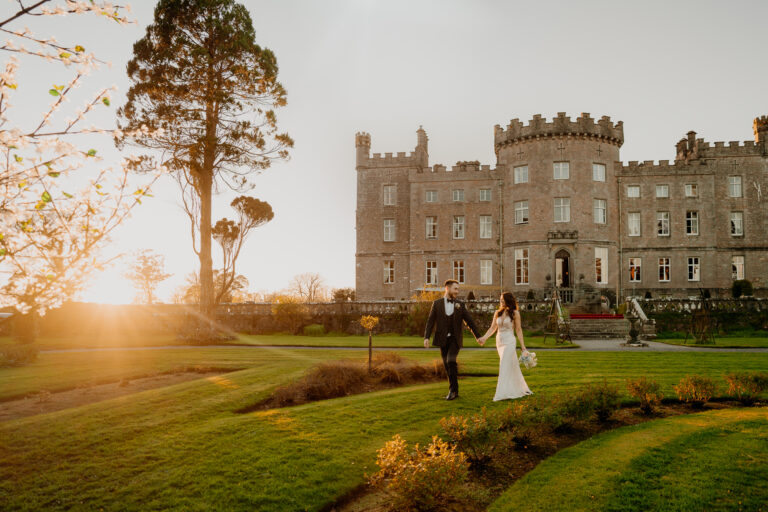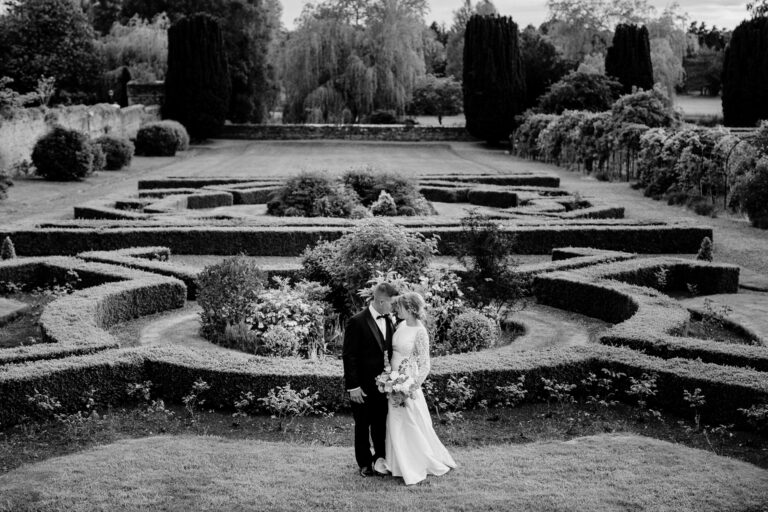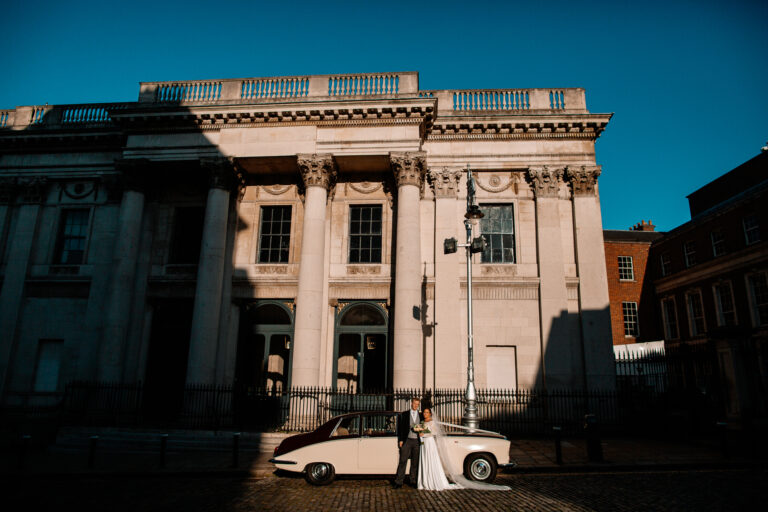
REAL ANALOGUE WEDDING PHOTOGRAPHY
Real Black & White 35mm Film, Alongside Digital
Alongside my digital wedding photography, I photograph selected moments on real black and white 35mm film. Not a digital preset made to imitate film. Not artificial grain added afterwards. Real photographic film loaded into an analogue camera, exposed one frame at a time, developed and scanned after the wedding.
Digital photography remains the foundation of how I document a wedding. Film has a different role: a carefully chosen analogue layer for moments where light, emotion, movement or atmosphere make me want to create another interpretation.
THE MEDIUM
What Is Film Wedding Photography?
Film wedding photography means creating photographs on physical photographic film rather than recording the image electronically on a digital sensor.
My current analogue wedding work is focused on black and white 35mm film. Light enters the camera and exposes the film inside it. There is no finished photograph appearing instantly on the back of the camera. The exposed film must later be developed and scanned before the final image can be viewed digitally.
A roll of 35mm film contains a limited number of exposures. That changes the rhythm of photographing. With digital cameras I can react instantly to a sequence of expressions and movement. With film I become more selective and decide which moments I want to commit to a physical frame.
GENUINE FILM
Real 35mm Film, Not a Film-Look Preset
There is an important difference between photographs captured on film and digital photographs edited to resemble film. A digital photograph can be given grain, softer contrast or tonal characteristics associated with analogue photography. That can be a beautiful aesthetic, but the original photograph is still digital.
When I describe my work as 35mm film wedding photography, I mean photographs genuinely exposed on photographic film. The original image begins as a physical negative. Its grain and many of its characteristics come from the film, exposure and development process rather than from applying a digital film effect afterwards.
WHY BLACK & WHITE?
Why I Chose Black and White Film for Weddings
Colour is an important part of a wedding. Flowers, clothing, interiors, landscapes and carefully chosen details all contribute to the story. My digital wedding galleries therefore continue to include colour as well as black and white photographs.
Film gives me an opportunity to approach selected photographs differently. By choosing black and white film, I deliberately remove colour and concentrate on expression, gesture, shape, texture and light. Sometimes a photograph becomes stronger when there is less information competing for attention.
A bride standing quietly beside a window. A parent’s expression during preparations. Hands during the ceremony. A couple walking rather than posing. A reaction during the speeches. Movement on the dance floor. These are the kinds of situations where I may decide that I want another interpretation on film.
DIGITAL + ANALOGUE
Digital Tells the Complete Story. Film Adds Another Interpretation.
I don’t see film and digital photography as competitors. Weddings move quickly and many moments happen only once. Digital gives me the speed and flexibility to document the complete day. Film sits alongside it, used selectively when I believe the medium can add something worthwhile.
MY APPROACH
Documentary Wedding Photography on Film
My approach to weddings is primarily documentary. I am interested in what genuinely happens between people: reactions, relationships, nervousness, laughter and the small moments occurring around the obvious ones.
Adding an analogue camera does not change that philosophy. I don’t want a wedding to stop because I have picked up a film camera. Most of the time I am watching what is already happening and deciding how best to photograph it.
During portraits I may give simple direction, just as I do when working digitally, but I still want couples to feel like themselves rather than perform for the camera. Film becomes another camera in the way I tell the story, not a separate production taking place during the wedding.
You can explore more of my wider wedding work at Wojciech Koza Photography.
THROUGH THE WEDDING DAY
Which Wedding Moments Work Well on 35mm Film?
I don’t work from a fixed analogue shot list. Every wedding has different people, light, locations and energy. There are, however, parts of a wedding day that naturally give me opportunities to use film.
Morning Preparations
Preparations often contain quieter moments: window light, mirrors, hands, clothing, parents, bridesmaids and groomsmen, small details and the anticipation before leaving for the ceremony.
Portraits in Natural Light
A simple portrait beside a window can sometimes say more than a complicated setup. With black and white film I can concentrate on the relationship between the person and the light without colour competing for attention.
The Ceremony
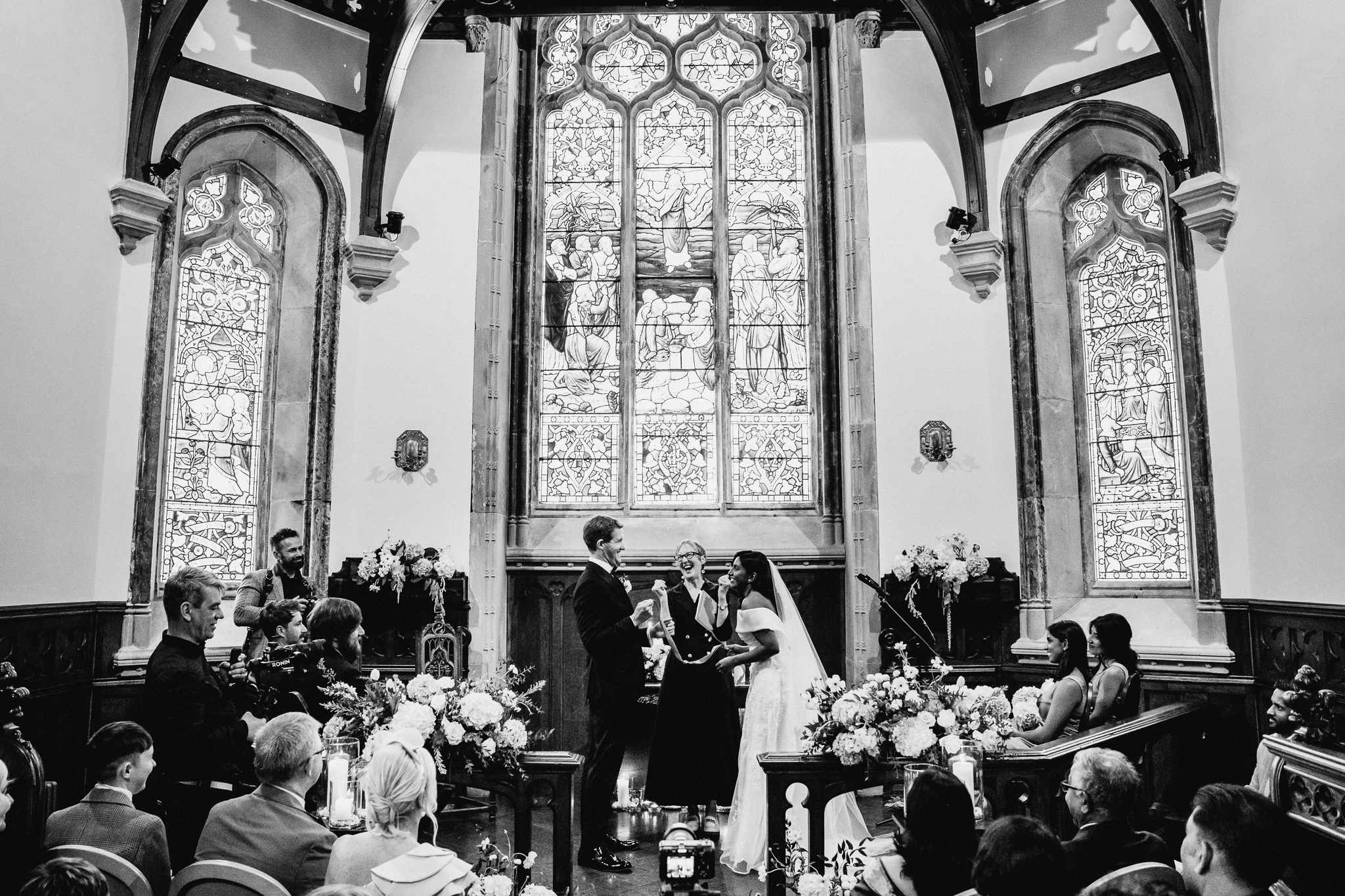
Ceremonies contain moments that cannot be repeated. Because my digital cameras remain responsible for the primary documentation, I can use film selectively when I see a frame particularly suited to it.
Couple Portraits
During a relaxed portrait session I can move between digital and analogue cameras and create two interpretations of the same part of the day. They do not need to look identical. That difference is one of the reasons to use both.
Guests and Unscripted Moments
Some of my favourite wedding photographs are not photographs of the couple at all. Parents, grandparents, children, friends, conversations and brief interactions often become more valuable as time passes.
Evening, Movement and Flash
Low light changes the technical decisions involved in using film, but it does not automatically mean putting the analogue camera away. Where conditions are appropriate, available light or flash can create photographs with a very different character from clean digital files.
IRISH LIGHT
Film Photography in Irish Light and Weather
Irish weddings rarely offer completely predictable light. A bright morning can become overcast, rain can arrive during portraits and historic venues can move from bright window light to very dark interiors within minutes.
For me, that is not a reason to avoid film. It is a reason to understand when to use it. Soft overcast light can be beautiful for black and white portraits. Window light can create shape and contrast indoors. Historic interiors can produce atmospheric frames when the exposure and subject are chosen carefully.
And when the conditions are better suited to digital photography, I use digital. The objective is not to prove that every situation can or should be photographed on film. It is to choose the right tool for the photograph in front of me.
35MM FILM AT MARKREE CASTLE
Photographing Markree Castle Weddings on Film
Markree Castle is one of the venues where I photograph selected moments on real black and white 35mm film alongside my digital wedding coverage.
I know Markree through photographing real weddings throughout the castle and its grounds. That familiarity is particularly useful when working with film. I know how the light changes through different parts of the building, where quieter moments tend to happen and which interiors can work particularly well in black and white.
The historic interiors, old windows, stonework, chapel, staircases and softer natural light give me opportunities to create analogue photographs without trying to make the wedding look artificially vintage. The character is already there. Film simply gives me another way to interpret it.
If you are planning a wedding at the venue, my Markree Castle Wedding guide brings together my wider experience of photographing complete wedding days there, including the venue, locations, light and real celebrations.
BLACK & WHITE AT MARKREE
My Wider Black & White Work at Markree Castle
My use of black and white photography at Markree Castle goes beyond analogue film. Monochrome photography has long been part of the way I document weddings digitally, particularly when expression, gesture, light or atmosphere become more important to the photograph than colour.
If you would like to see more of that approach, you can explore my black and white wedding photography at Markree Castle. The photographs in that feature were created digitally rather than on 35mm film, so I do not present them as examples of analogue photography. They show the wider monochrome style that also influences the way I see and use black and white film.
As I create new analogue work at Markree, I will continue adding genuine film photographs to this guide. For a broader view of complete celebrations at the venue, you can also browse my Markree Castle wedding photos and real weddings.
TWO DIFFERENT TOOLS
Is Film Better Than Digital Wedding Photography?
No. And digital is not automatically better than film either.
Modern digital cameras allow me to work quickly, quietly and consistently in rapidly changing conditions. Film introduces a physical process, a finite number of exposures and the need to trust exposure and timing without immediately reviewing the finished photograph.
The reliability of my digital coverage is what gives me the freedom to use analogue photography selectively rather than asking film to carry the responsibility for every important moment.
THE CHARACTER OF FILM
Grain, Texture and the Imperfection of a Physical Medium
Film does not need to look clinically perfect to be successful. Grain, slight variations in exposure and the physical character of the medium are part of what makes analogue photographs feel different from digital files.
I am not trying to manufacture imperfection for its own sake. I am interested in the way a physical photographic process interprets light, movement and people, particularly when those characteristics support the emotion of the photograph.
AFTER THE SHUTTER
What Happens to the Film After the Wedding?
Once a roll has been exposed, the photographic process is not finished. The film must be developed before the images can be seen, and the negatives can then be scanned to create high-resolution digital files.
Those scans allow the analogue photographs to sit naturally alongside the main digital wedding gallery and make them easy to view, share and print.
The important difference is where the photograph began: the original exposure was created on a physical strip of photographic film rather than on a digital sensor.
BEYOND THE WEDDING DAY
Engagement Sessions, Elopements and Intimate Weddings on Film
Analogue photography does not need to be limited to a full wedding day. Engagement and pre-wedding sessions are particularly natural environments for combining digital and 35mm film.
There is more time to observe the light, move between locations and create both relaxed portraits and unscripted photographs without the fixed schedule of a wedding day.
Film can also work beautifully for intimate weddings and elopements. A smaller celebration can contain long stretches of quiet interaction, movement and portrait opportunities that suit a selective analogue approach.
ACROSS IRELAND
Film Wedding Photography Across Ireland
I am based in Sligo and photograph weddings throughout Ireland, including couples travelling here from abroad for destination weddings and elopements.
Black and white 35mm film can be incorporated into suitable wedding and engagement coverage at castles, country houses, hotels, coastal locations and intimate ceremonies across Ireland.
The location changes. My approach remains the same: digital photography documents the complete story while film is used selectively to create an additional analogue interpretation of particular moments.
WHY FILM?
Why Add Film When Digital Cameras Are Already So Good?
Precisely because digital cameras are so good. I don’t need film to compensate for something my digital equipment cannot do. Modern digital cameras allow me to work with extraordinary speed and consistency. That gives me the freedom to use film selectively, for the photographs where I believe another medium can add something to the story.
QUESTIONS & ANSWERS
Film Wedding Photography Ireland FAQ
A few of the questions couples often have about combining real 35mm film with digital wedding photography.
Do you really photograph weddings on film? +
Is this actual analogue film or a digital film preset? +
Do you photograph the entire wedding on film? +
Why do you currently use black and white film? +
Will we still receive our normal digital wedding gallery? +
Can 35mm film be included in our wedding photography? +
Can you photograph on film indoors or in poor weather? +
Can you use flash with 35mm film? +
Can engagement sessions and elopements be photographed on film? +
Do you photograph Markree Castle weddings on film? +
A PHYSICAL PROCESS IN A DIGITAL WEDDING DAY
Real People. Real Weddings. Real Moments. Real Film.
Wedding photography changes constantly. Cameras change, editing trends change and the way photographs are viewed and shared changes. My interest in analogue photography is not about applying a fashionable film effect to an entire wedding gallery. It is about bringing a physical photographic process into the documentary approach I already use.
The photographs on this page will continue to evolve as I create new analogue work at real weddings and engagement sessions. The principle behind it remains the same.
Digital documents the complete story. Film becomes a carefully chosen analogue layer within it.
INTERESTED IN REAL 35MM FILM?
Include Analogue Photography in Your Wedding Story
If you are drawn to genuine black and white 35mm film, tell me about it when you get in touch. You do not need to decide in advance which moments should be analogue. I will document the complete wedding digitally and look for the photographs where real film can add another interpretation of the day.
Tell me your wedding date, venue and what you love about the idea of adding real film to your photographs.